Electric Vehicle Center
Nissan of Costa Mesa / Electric Vehicle Center
California EV Guide & Charging Hub in Costa Mesa
Explore the benefits of electric driving in Southern California. Find charging stations near Costa Mesa, learn about charging and ownership, and explore new Nissan electrified models or pre-owned EVs at Nissan of Costa Mesa.
Serving Costa Mesa, Newport Beach, Huntington Beach, Irvine, Fountain Valley, and surrounding Orange County communities.
Public charging near you
Find EV Charging Stations in Costa Mesa & Orange County
Need to charge before heading down the 405, visiting Newport Beach, or commuting toward Irvine? Use the interactive ChargeHub locator below to explore public charging options near Costa Mesa. Zoom, pan, and use the map’s filters to explore locations and connector types.
Check your vehicle’s charging port and supported DC fast-charging standard. Some public stations require an app, account, adapter, or specific vehicle compatibility. Charging speeds also vary by vehicle, charger, and battery conditions.
Why drivers go electric
Benefits of Owning an Electric Vehicle
Drivers in Costa Mesa, Newport Beach, Huntington Beach, Fountain Valley, Irvine, and Santa Ana have many reasons to consider electric driving. Battery-electric vehicles offer smooth acceleration, no tailpipe emissions, home-charging convenience, and fewer engine-related service needs. Whether an EV fits your lifestyle depends on where you charge, how far you drive, and overall ownership costs.
Fewer Routine Maintenance Items
Fully electric vehicles don’t require engine oil changes, spark plugs, or traditional exhaust-system service. Tires, brakes, cabin filters, and other systems still need attention.
Potential Savings on Energy
Depending on your home electricity rates, charging plan, and driving habits, electricity may cost less per mile than gasoline. Public fast-charging prices can vary considerably.
Quiet, Smooth Acceleration
Electric motors provide responsive acceleration without conventional transmission shifts and generally deliver a quieter drive through city traffic.
Convenient At-Home Charging
If you have suitable parking and electrical access, plugging in at home can simplify your daily routine by allowing you to start many mornings with a charged battery.
No Tailpipe Emissions
Fully battery-electric vehicles produce no tailpipe emissions while driving. Overall environmental impact depends on electricity generation, manufacturing, and vehicle use.
Modern Driving Technology
Depending on the model and trim, EVs can include energy-monitoring tools, route planning, connected apps, and regenerative braking functionality.
Planning your EV purchase? Compare the vehicle price, electricity rate, insurance, charging access, and tire costs—not just the savings from skipping the gas station. See our ownership-cost guide →
Electric vehicle shopping
Shop New Nissan EVs & Used Electric Vehicles in Costa Mesa
Ready to explore electric driving? Nissan of Costa Mesa offers online shopping resources for new Nissan electrified models and a changing selection of pre-owned vehicles. Browse the options below, then contact the dealership about actual availability.
100% Electric Nissan
New Nissan LEAF
Explore Nissan’s all-electric LEAF, including available features, configurations, and local shopping options.
The LEAF runs entirely on battery power, with no gasoline engine. Explore the 2026 model’s features, driving range, and charging setup, then ask the dealer to confirm current inventory.
Plug-In Hybrid Nissan
New Nissan Rogue PHEV
Explore a plug-in hybrid option that combines electric-only driving capability with a gasoline engine.
The Rogue PHEV is a plug-in hybrid, not a fully electric vehicle. It’s worth considering if you want the option to plug in but also take longer trips using gasoline.
Pre-owned electric vehicles
Browse Used EVs & Other Pre-Owned Vehicles
Explore the dealership’s pre-owned selection, including electric vehicles when available. Use the inventory filters or search for specific EV makes and models.
Pre-owned inventory contains gasoline and electric models; filter or search to find available EVs.
Pre-owned electric selection
Shop Used Tesla Vehicles
Looking beyond Nissan? Explore pre-owned Tesla Model Y listings from the dealership inventory. Other used EV makes and models may appear in the broader used-vehicle selection.
Used EV buyer’s checklist: Ask about battery health, remaining battery warranty, charging connector type, DC fast-charging compatibility, service history, and the vehicle’s real-world driving needs. Listings and eligibility for certification vary.
EV charging made simple
How Does Electric Vehicle Charging Work?
EV charging can happen at home, at work, or at public stations. The right option depends on where you park, how far you drive, and which charging equipment your vehicle supports.
Everyday Outlet Charging
Uses compatible equipment connected to an appropriate 120-volt household outlet. Charging is relatively slow and is best suited to lighter daily driving or overnight top-ups when your vehicle and electrical setup support it.
Faster Routine Charging
Generally uses a dedicated 240-volt home setup or a commercial Level 2 station. Often a practical choice for overnight home charging. Professional installation may be necessary.
Charging on the Go
High-power public stations can add driving range more quickly on compatible vehicles. Actual charging performance depends on the battery, charger power, temperature, and current state of charge.
Charging compatibility
Know Your EV’s Charging Connector
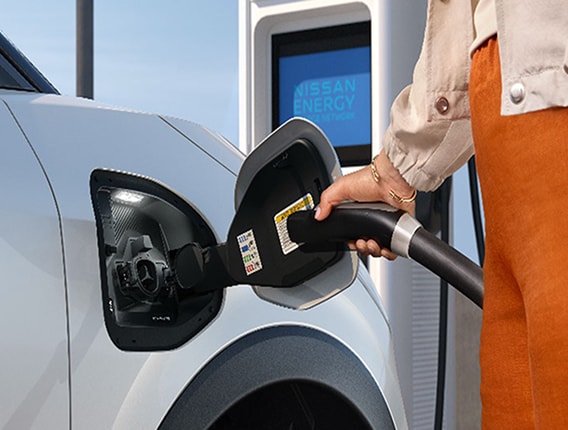
Charging standards can differ by vehicle and model year. For example, the 2026 Nissan LEAF uses a J1772 port for Level 1 and Level 2 charging and a NACS port for supported DC fast charging. Older Nissan EVs may use a different fast-charging connector.
Before buying a used EV or planning a longer drive, check the specific vehicle’s ports, charging capabilities, and any required adapters.
Make charging part of your routine
Installing an EV Home Charger in Costa Mesa
For drivers with a driveway or dedicated parking space, home charging is often the most convenient way to keep an EV ready for daily trips around Orange County. Your electrical panel, parking situation, and driving needs will determine the right setup.
Evaluate Your Parking & Electrical Panel
Confirm where the vehicle will park and have a licensed electrician review your available electrical capacity. Some homes require an outlet, circuit, or service-panel upgrade.
Choose Compatible Equipment
Confirm the connector standard for your exact EV and whether an approved 120-volt or 240-volt charging solution fits your daily driving and charging needs.
Check Permits & Utility Programs
Ask your installer about applicable local permit and inspection requirements. Eligible Southern California Edison customers can check for home-charging installation incentives before starting work.
Southern California Edison resource: Review eligibility and terms for the Charge Ready Home program. Funding, service-territory requirements, and reimbursement amounts can change; the program is not guaranteed for every household.
Plan for the complete ownership experience
EV Maintenance & Ownership Costs
A battery-electric vehicle has fewer conventional engine service needs than a gasoline-powered car, but it still requires inspections and wear-item maintenance. Charging costs also depend on your electric rate, driving habits, and use of public fast chargers.
| Ownership item | Fully electric vehicle | What to keep in mind |
|---|---|---|
| Oil changes | No engine oil changes | Battery EVs do not have gasoline engines, but plug-in hybrids do. |
| Brake service | Still required | Regenerative braking may reduce brake-pad use, but brakes still need inspection. |
| Tires & alignment | Still required | Tire replacement and alignment needs depend on weight, torque, mileage, and driving style. |
| Cabin filters & fluids | Still required where applicable | Follow the specific vehicle’s recommended maintenance schedule. |
| Energy costs | Electricity rather than gasoline | Compare home utility rates and public charging prices to gasoline expenses. |
| Battery condition | Important to monitor | For used EVs, ask about battery health and remaining warranty coverage. |
Buying a used EV? Ask about its battery state of health, charging ports, fast-charging ability, remaining warranty, accident and service history, and charging accessories. Compare total costs—not just the asking price.
Updated for California EV buyers
California EV Incentives, Rebates & HOV Lane Rules
Financial incentives and driving privileges have changed significantly. Before purchasing an EV, verify programs using an official government or utility source and confirm your vehicle, income, location, and installation eligibility.
Federal purchase tax credits
Previous EV Purchase Credits Have Ended
The federal new and previously owned clean-vehicle purchase tax credits are not available for vehicles acquired after September 30, 2025. Some purchases contracted before that date may have separate transition rules.
California HOV access
No EV-Only Single-Occupant Carpool Exemption
California’s Clean Air Vehicle decal program expired September 30, 2025. Beginning October 1, 2025, EV drivers must meet posted HOV occupancy requirements like other passenger vehicles.
Local / utility programs
Home-Charging Assistance May Be Available
Some income-qualified or utility-area programs may help eligible households with EV charging equipment or electrical upgrades. Availability, funding, and application requirements can change.
Important: Do not assume an EV qualifies for a rebate, tax incentive, free parking, reduced toll, or HOV-lane exemption without checking the current terms. Visit the California DriveClean portal for additional current-program resources.
EV ownership questions
Electric Vehicle FAQs for Costa Mesa Drivers
Where can I find public EV charging stations near Costa Mesa?
Use the ChargeHub interactive charging map above to browse public charging locations around Costa Mesa and nearby Orange County communities. Before leaving, confirm the charger’s location, connector compatibility, access rules, and current status with the network operator.
What is the difference between Level 1, Level 2, and DC fast charging?
Level 1 typically uses compatible equipment on a 120-volt outlet, Level 2 uses a higher-power AC charging setup, and DC fast charging uses specialized public equipment. Speed depends on your EV’s capabilities, charger output, battery condition, and other factors.
Can I charge an electric vehicle at home?
Many EV owners charge at home using compatible Level 1 or Level 2 equipment. A qualified electrician can help assess whether your home’s electrical system and parking area can support the setup you want.
Are electric vehicles cheaper to maintain than gasoline vehicles?
Fully electric vehicles eliminate some traditional engine-related maintenance, including engine oil changes. However, tire service, brake inspections, cabin filters, battery and electrical checks, and other maintenance still apply. Overall ownership costs vary by vehicle and driving conditions.
Does the Nissan LEAF use the same charging connector as every other EV?
No. Charging connectors and fast-charging capabilities can differ by model year. The 2026 LEAF includes J1772 for compatible AC charging and NACS for supported DC fast charging, while earlier LEAF models may use other connectors. Always check your specific vehicle.
Does Nissan of Costa Mesa sell pre-owned electric vehicles?
The dealership offers pre-owned inventory that can include electric vehicles, depending on availability. Browse its used-vehicle listings and search for the electric models you are considering. Contact the sales team to confirm current stock.
Are federal tax credits still available for a new or used EV in 2026?
No. The previous federal new and used clean-vehicle purchase tax credits are not available for vehicles acquired after September 30, 2025. You can check the IRS for transition rules relating to qualifying earlier acquisitions.
Can I drive alone in California carpool lanes just because my car is electric?
No. California’s Clean Air Vehicle decal program ended September 30, 2025. Starting October 1, 2025, EV drivers must follow posted vehicle-occupancy rules for HOV lanes.
Are there utility rebates for installing a home EV charger?
Some customers may qualify for utility or local incentives, including programs offered by Southern California Edison in eligible service areas. Check current eligibility, available funding, and documentation requirements directly with the utility before purchasing equipment.
What is the difference between a fully electric vehicle and a plug-in hybrid?
A battery-electric vehicle such as the Nissan LEAF runs on electricity alone. A plug-in hybrid such as the Nissan Rogue PHEV combines a rechargeable battery and electric driving with a gasoline engine for additional flexibility. Maintenance needs and fuel expenses differ between the two.
Your next electric vehicle starts here
Explore Electric Driving at Nissan of Costa Mesa
Compare the latest Nissan electrified models, browse pre-owned options, and find public charging before you go. Our team can help you understand available vehicles and choose an option that fits your Orange County driving routine.
